Pulse
The board
The board shows all your systems, with a reading from each and alerts ordered by urgency. You can switch between four views without changing the data.
Four views
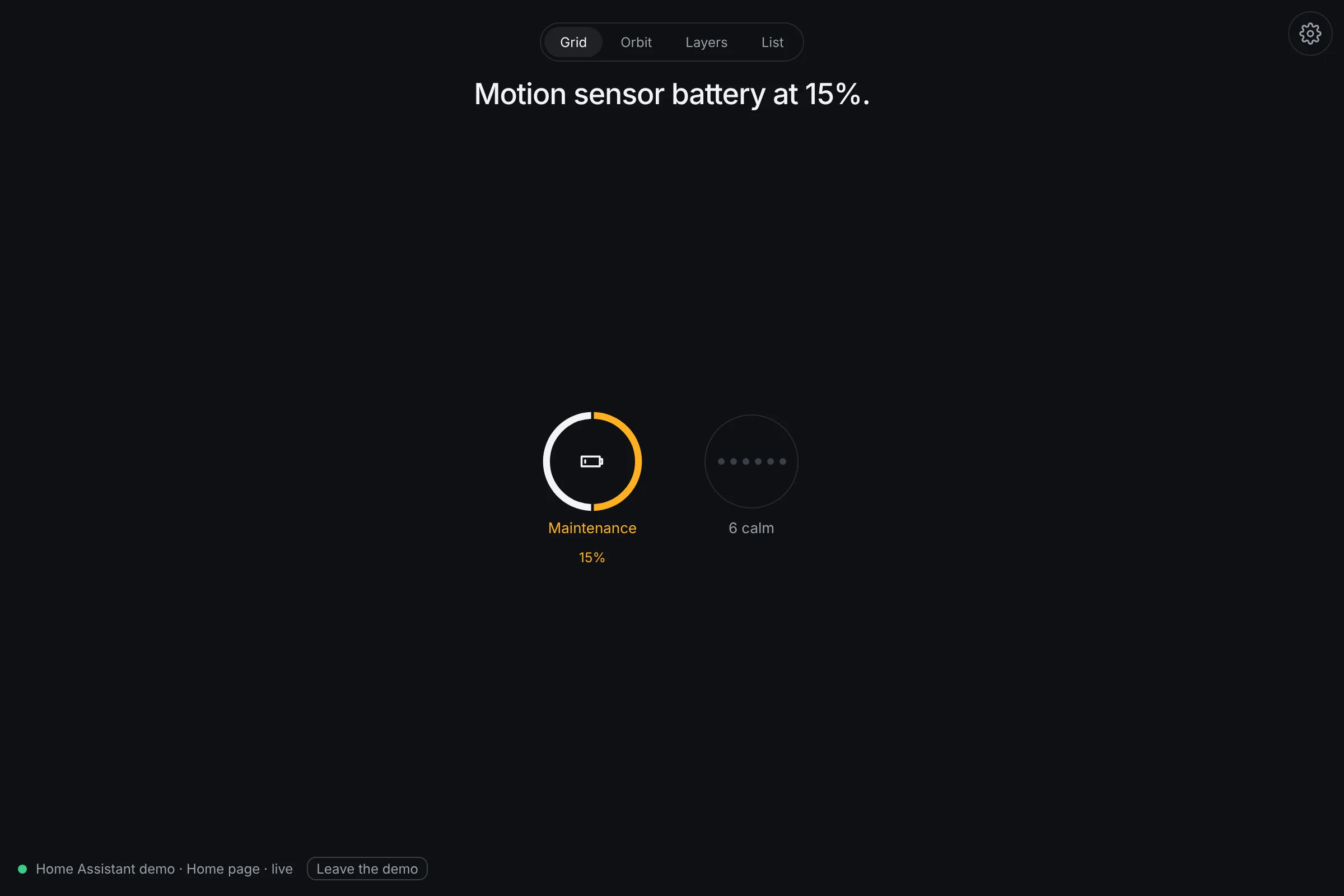
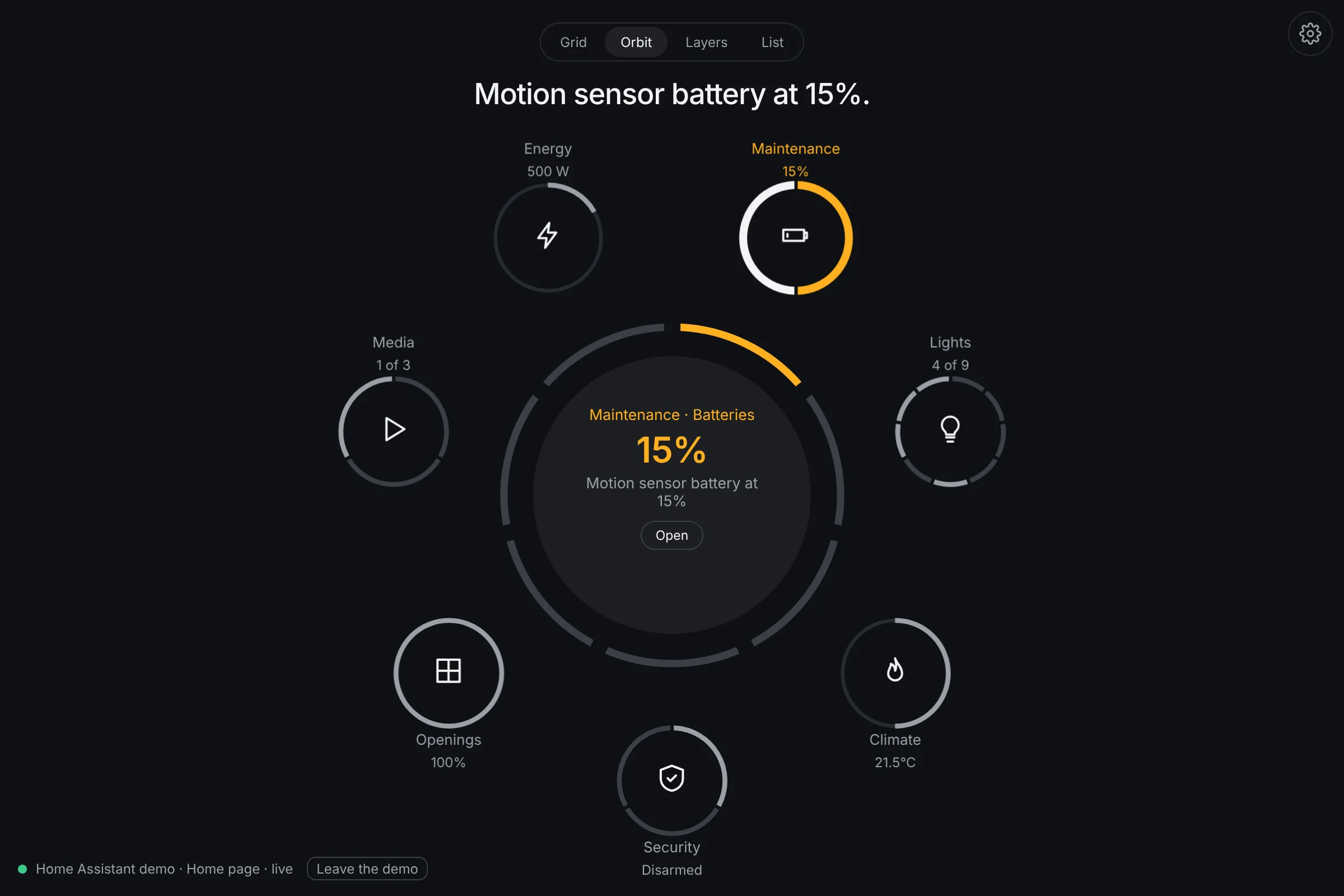
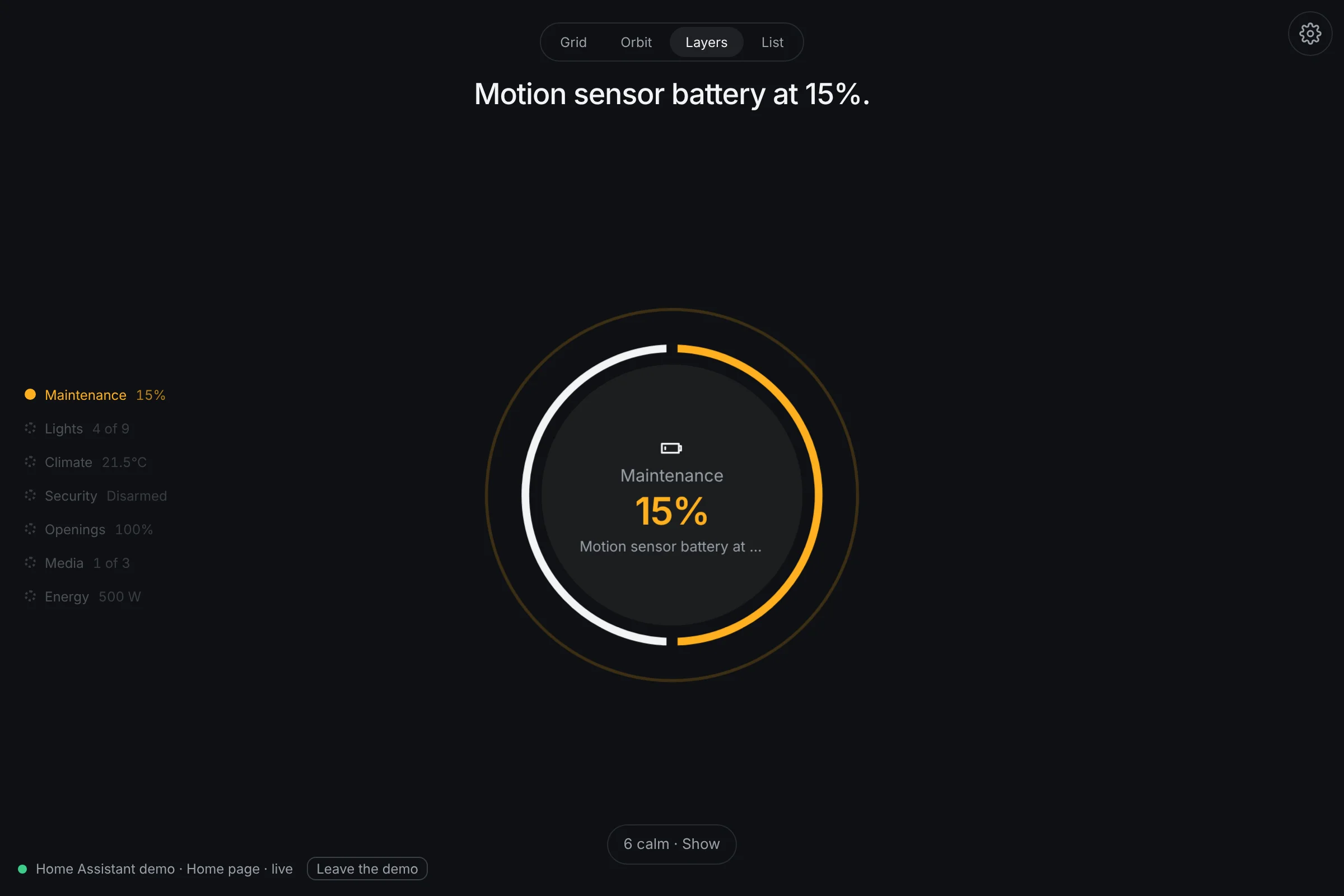
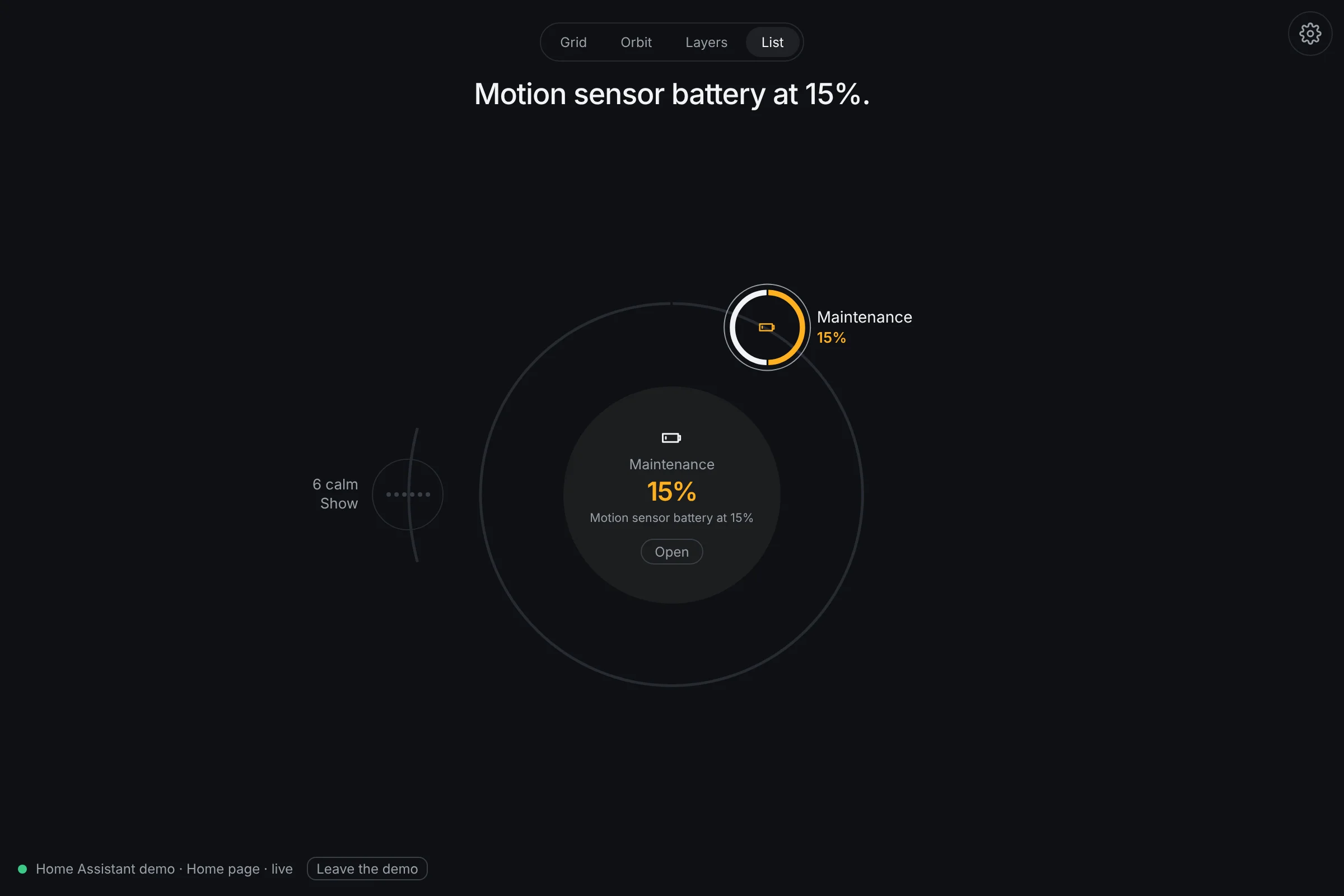
Two axes
A home can be grouped by what things do or by where they are. Pulse has both, over the same four views.
- By system. Lights, climate, security, openings, media, energy, scenes, maintenance. Each system's channels are its layers.
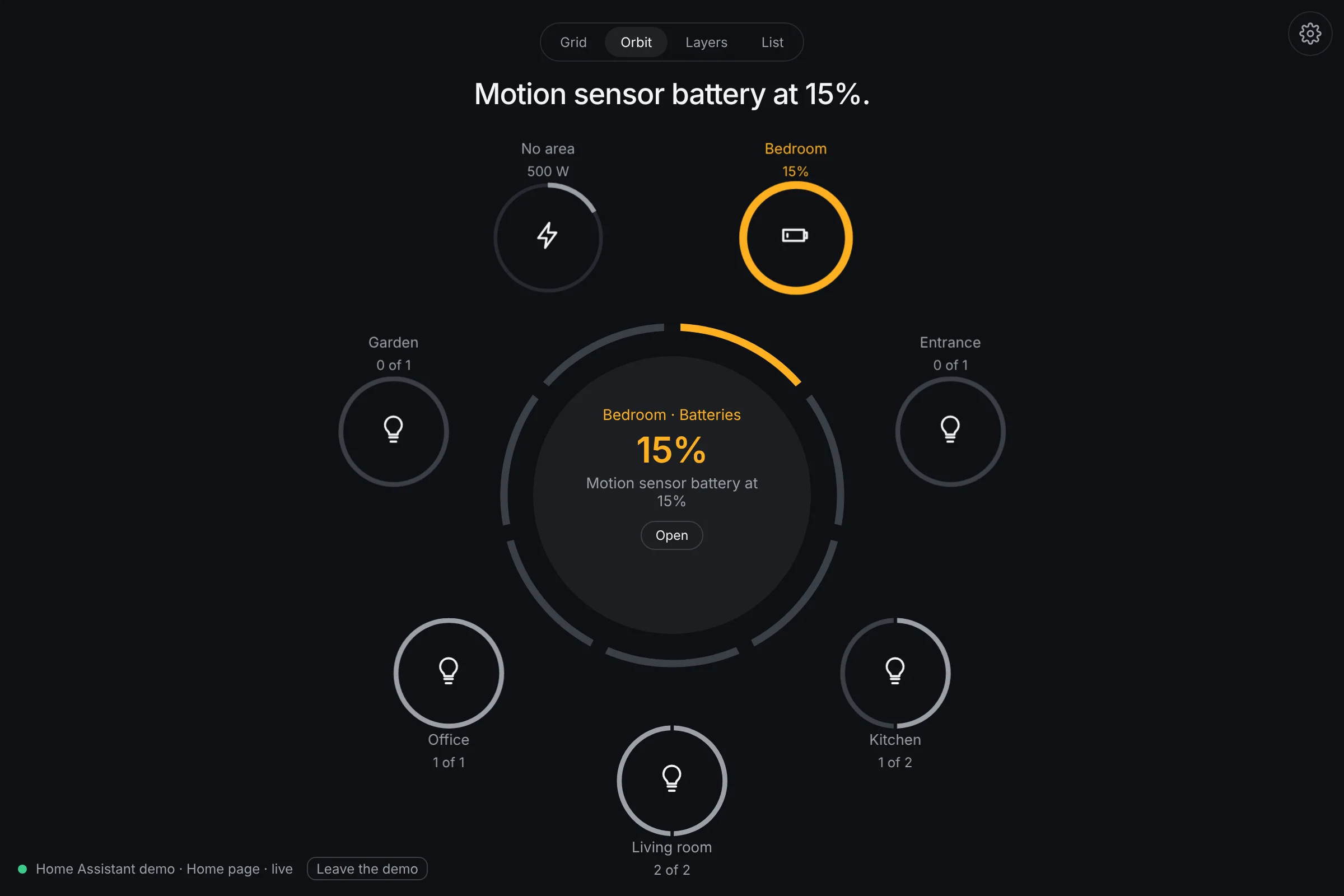
- By room. Each area is one object. Its channels are the systems' channels read within that room: the kitchen's lights, its plugs, its humidity, its speaker. Floor by floor. What has no area is a room of its own.
The pulse
The center of the orbit is the home's pulse. With something calling, it holds the most serious alert and a way in; the rest call from their own rings around it. With nothing calling, it shows the latest changes. Its ring has one segment per system, painted when that system calls.
Time, if you want it
Time is optional, from the gear. Every ring that shows it reads the same way: now at the top, the past running clockwise into it, fainter the older. The orbit's center ring keeps one segment per system, each pointing at its satellite with a small triangle; a gap in, the news: the last 12 hours as a faint wake, and each alert still open as a dot at the moment it began (the one in the face sends out a wave). A line crosses the face: above it, now, the alert with its action and, when several are open, a dot each to step through them; under it, before, in grey, the last change and how many there were. That count opens all of them, scrolled in a circle, the whole text of the one in focus in the middle and the way to its system. With the clock, while all is calm the time sits above the line and the day runs around it, each hour as tall as what changed in it. The energy month can follow the same rule: the last 30 days, today at the top.
The same head everywhere
Every view keeps its head in the same place: the headline, what calls or that all is calm, and above it the view switch when the gear shows it. The connection sits in the bottom left corner; in the top right one, the gear and next to it the way out (sign out, or leave the demo). Nothing under the object feeds the latest changes; the orbit's center shows them when there is nothing else to say.
Order
Every view queues by urgency: the ones calling first, the most serious first, then the usual order. Picking one by hand puts it in the center or in front, but nothing else moves to make room. A critical alert opens its system on its own.
What is fine, folded
While something calls, the systems that are fine fold away: one quiet tile in the grid, one button under the layers, one button on the list's outer ring. Open them once and that screen remembers. With nothing calling there is nothing to fold.
How an alert looks
What calls never changes size. Its ring is drawn heavier, in its alert's tone, and a wave leaves it and fades, quicker when it is serious. What is fine is a thin line in a quiet tone.
The gear
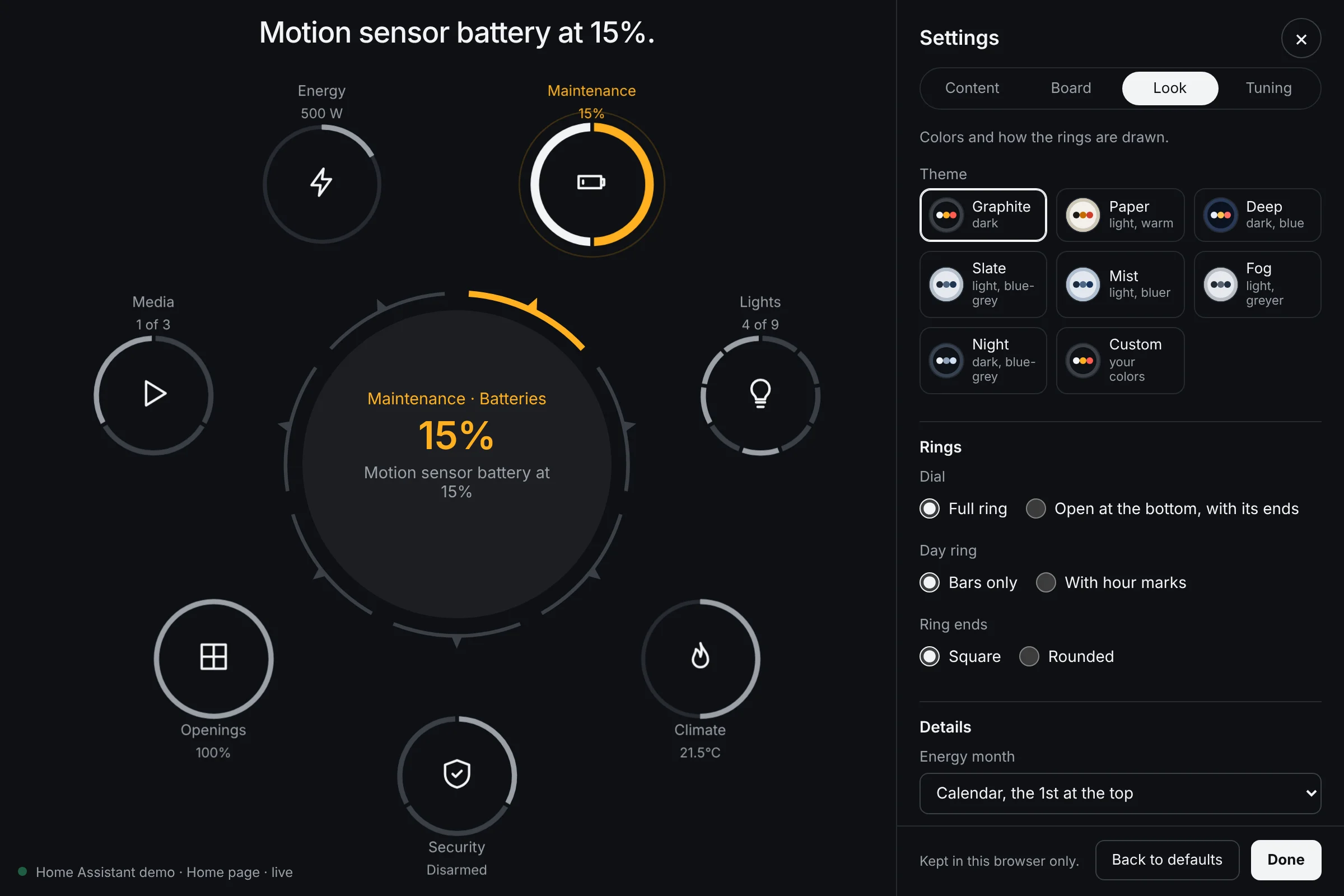
Whoever looks at a screen can tune it without touching the setup: the gear at the top right opens a panel in four tabs. Changes apply as they are made and are kept in that browser only, so the tablet in the kitchen and the phone in a pocket can show different things from the same source. On a wide screen the panel sits at the side and the board moves over, so what changes stays in view; on a narrow one it covers the board.
| Tab | What it chooses |
|---|---|
| Content | Which systems the board shows; only what is in some areas, grouped by floor; which channels each system shows and, for a channel that follows one entity, which one |
| Board | Grid, orbit, layers or list, and whether the switch between them shows on the board; systems or rooms; the board or a system to open in; time in the orbit (nothing, the changes of the last 12 hours, the clock while all is calm, or both); how many systems the layers view stacks and how many channels a system stacks |
| Look | The theme: Graphite, Paper or Deep, which tell an alert by hue; Slate, Mist, Fog and Night, which keep to one blue-grey family and tell it by tone; or your own seven colors. Behind the board, the flat ground, a glow, one of three abstract grounds the browser draws from the theme's own colors (Aurora, Contours, Grain), or a photo (chosen in that browser, or an address such as /local/living-room.jpg) with a veil and a blur; over any of them the faces can be solid or glass. The dial full or open at the bottom, the day ring bare or with hour marks, ring ends square or rounded; the energy month as a calendar or the last 30 days |
| Tuning | Distances and sizes of the orbit, of time in the orbit and of the layers, as sliders that move the board while dragged; a reset per group, and the values to copy |
The host sets the frame: which systems and areas the gear may offer, and the defaults. "Back to defaults" returns to what the host said.
On a phone
A phone looks at one system at a time: two visible layers, the systems as dots under the object to move sideways, and the one calling the most opens first. The board is one step out.